

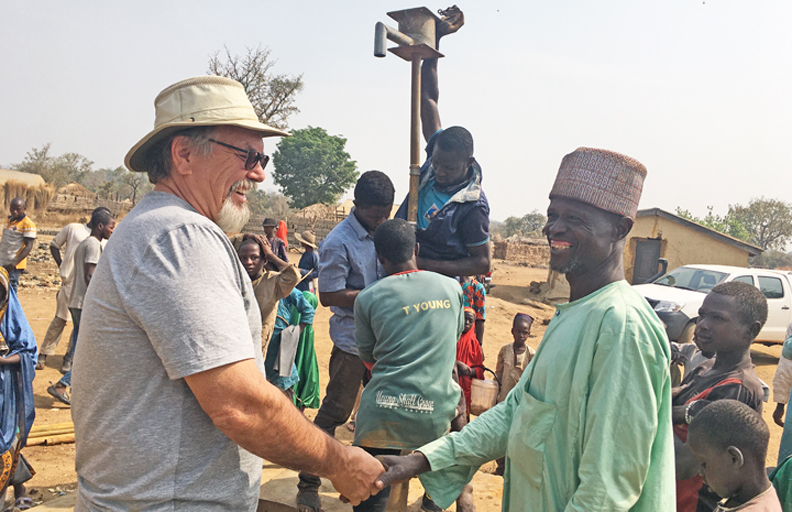
(Thomas Froese Photo)
In this 2020 scene, Hamiltonian Rick Bradford shakes hands with a Hausa chief grateful for help to repair his town’s water pump. Bandits in the area, near Egbe, Nigeria, now make such mission help impossible.
(The Hamilton Spectator – Saturday, December 6, 2025)
It’s the phone and it’s your friend, Hamiltonian Rick Bradford, from the other side of the world. You talk about it all, what’s happening in Nigeria. The kidnappings. The fear. The corruption.
Rick, a former Stelco worker of 30 years and lay leader at Philpott Memorial Church, moved to the West African nation in 2014 with the global mission SIM. In usual times he’s building water wells or schools or helping with medical needs. God knows the place needs the help.
You’ve been there. You’ve seen enthusiastic Nigerian children giving thanks for a new school. You’ve seen the respect given Rick by village people and chiefs alike. You’ve ridden motorcycles, the two of you, up to a place called, fittingly-enough, Prayer Rock, to look with some perspective over where he’s based in the town of Egbe, in north central Nigeria.
That was just before the COVID pandemic hit. Nigeria never really recovered and now about two-thirds of its 237 million people live in multi-dimensional poverty.
Now the kidnapping surge. It seems like it’s some wild west, a frontier where it’s every man, every child, really, for themselves. Rick’s understanding of it? It’s a lucrative cash grab by outlaws more and more emboldened by government failure.
It’s reported that more than 1,500 Nigerian school children have been abducted since 2014. Some escape. Some are freed. Others are never heard from again.
November was especially disturbing. About 300 girls were taken from St. Mary’s Catholic School in Niger state. Four days prior, in a school in Kebbi state, gunmen took 25 students and killed a teacher. A day later, in Eruku, just a few kilometres from Rick’s home, 38 worshippers were kidnapped from Christ Apostolic Church.
Two were killed, the others released, this after kidnappers demanded 100 million Nigerian naira. The government denies paying – it’s illegal to pay ransoms in Nigeria – but it’s commonly believed money was given.
And if you’re of more humble means? You’ll sell anything to get a loved one back. Your animals. Your land. “Anything you have,” Rick notes. But imagine a ransom of 10 million naira, about $10,000 Cdn, when your yearly salary is less than one-tenth of that.
Kidnappers are often Boko Haram or the Islamic State West Africa Province. Whether in Nigeria’s largely Muslim north or, more recently, its largely Christian south, innocents are terrorized by such Islamic jihadists. Then there are the so-called “bandits,” Fulani herdsmen driven less by religious ideology and more by money and the thrill of terror.
The International Committee on Nigeria, which promotes human rights and religious freedom, reports that between 2000 and 2020 as many as 43,000 Nigerian Christians were killed by Boko Haram and 19,000 by the Fulani.
Rick knows the Fulani well, having worked with tribesman for several years. Leaving nomadic life, some Fulani are interested in peace and security and education for their children. Others not so much.
“Historically all they’ve had were machetes. So people might lose an arm or a leg or a hand. That’s what a hospital might see,” explains Rick. Now they’re well-resourced with motorcycles and guns. In Nigeria you can get an AK-47 for $550 Cdn. Add another $150 for 100 bullets. And ransoms paid mean more money for more guns and attacks.
And Nigeria’s government? The alleged corruption? Consider U.S. president Donald Trump’s threat to invade the nation if its leaders can’t get a handle on the crisis. “This has now really shaken things up,” notes Rick, “because corrupt people don’t want to be exposed.”
In the meantime fearful farmers let crops rot in their fields. More bandits move from rural areas into villages and towns. Schools have already closed early for the holidays. And the government has restricted hours for places of worship, effectively curbing religious freedom and public gatherings even more.
This is Nigeria during the Advent season 2025.
“Pray for the people here,” Rick says. “Pray for the Christians.”
May God intervene and bring security to Nigeria.
This is absolutely appalling, sinful and totally unacceptable. Nigeria and its precious children need our prayers nonstop. My heart is breaking for all who are completely innocent in this situation.
Many hearts are breaking.
And may God intervene through humans.