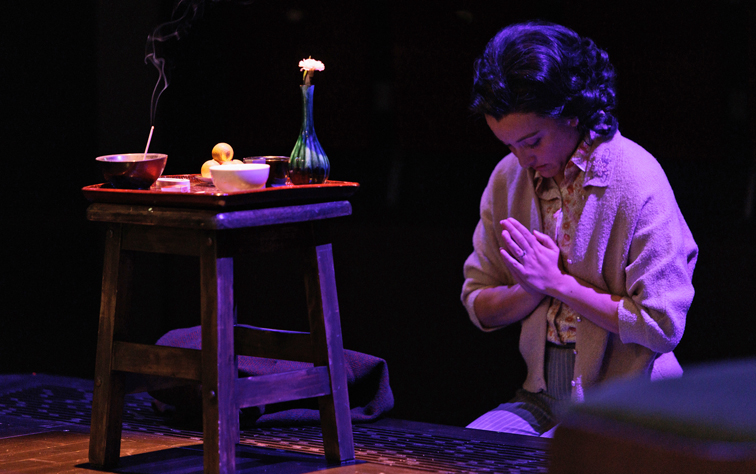
Yoshie Bancroft as Mitsue in Forgiveness, now showing at the Stratford Festival.
(The Hamilton Spectator – Saturday, Aug 9, 2025)
“Forgive and forget” is how the old expression goes, but the sorry truth is that it doesn’t work. It’s better to forgive and remember, then forgive again. We’re not made, or meant, to forget.
Not that anyone said forgiveness is easy. That’s why the word “give” is embedded in “forgive.” Forgiving is hard, even as remembering can be hard.
Today is a day in history to remember. But before going there, here’s something about giving. It involves an 8-year-old boy whose sister was dying of leukemia.
Looking for a match, his parents and doctors asked if they could test his blood. The boy said yes, sure. It was discovered his blood matched, so he was then asked if he’d donate a pint. It might be his sister’s only chance of living. The boy said he’d like to think about it overnight. The next day he told his parents, yes, he’s willing.
Soon he lay on a hospital gurney beside his six-year-old sister, both children hooked into IVs. The boy closed his eyes and waited quietly while his blood left his body and dripped into hers. The doctor came to check things. This is when the boy opened his eyes and said, “How soon until I start to die?”
This, a true story from Jack Kornfield of the Spirit Rock Meditation Centre, is really something. The naïve innocence. The sacrificial love. It’s a real-life parable illustrating the power of giving from your deepest place. This is forgiveness.
If you’re like me maybe you’ve also discovered that forgiving usually doesn’t involve some monstrous stranger out there, but familiar people in our daily affairs, often loved ones, people who might trespass against us even as, of course, we trespass against others.
True, there’s also the news of our world. Consider Gaza. Or Ukraine. Or consider on Aug 9, 80 years ago today, an atomic bomb was dropped on Nagasaki, the Japanese city. Three days earlier it was Hiroshima. In the blinding flash, death swallowed life many thousands of times. Forgive? Really? How?
Canadian author Mark Sakamoto, who wrote the family memoir “Forgiveness: A Gift from My Grandparents,” knows something about this. He knows about remembering and family war scars and the experience of about 22,000 Japanese-Canadians sent to internment camps during the xenophobia that gripped Canada in the Second World War.
He didn’t forget. He wrote about it.
The Stratford Festival has now adapted Sakamoto’s book. My view, after watching the play, is that this is the sort of theatre that you should run, not walk to. Then send loved ones. Then the neighbours. Because this is what this production, so well executed, says: Forgive. Remember. Repeat.
Or consider Wilma Derksen, mother of Candace, an innocent 13-year-old Winnipeg girl abducted then murdered while walking home from school. I recently heard Wilma in a podcast.
How many times has she forgiven her daughter’s killer? Seven times? Seventy times? Seventy times seven? Four decades after the crime, she’s still forgiving, she says, as many times as the day has moments. Because forgiveness is a process as much as a one-time decision.
This is what we talk about when we talk about forgiveness. We talk about relationship, even with our inner selves.
This isn’t glib. Or cheap grace. It doesn’t deny pain, or even death. It simply says this: When you remember, and you will, then forgive. When you remember again, and you will, then forgive again. And so on. Let it go. How many times? Seventy times seven. And then some.
Because the alternative is no alternative. The alternative is unforgiveness. Bitterness. Captivity. This, as Nelson Mandela phrased it, is like drinking poison and then hoping it will kill your enemy.
No, don’t be fooled. Forgiveness is for the victim as much as any perpetrator. It frees your soul. This is why forgiveness is so powerfully healing. It’s like receiving new blood.
God knows we need it as much as ever.
Thank you, Thomas, for that all-to-necessary reminder.
To Sakomoto’s book I would add, Saxton’s, “Father, forgive them for they know not what they do”.
Blessings
Peter D
Thank you for this reminder, to me, and all of us. Jesus said on the Cross, “Father forgive them, for they know not what they do”
Indeed.
Thank you for that title, also, Peter.