
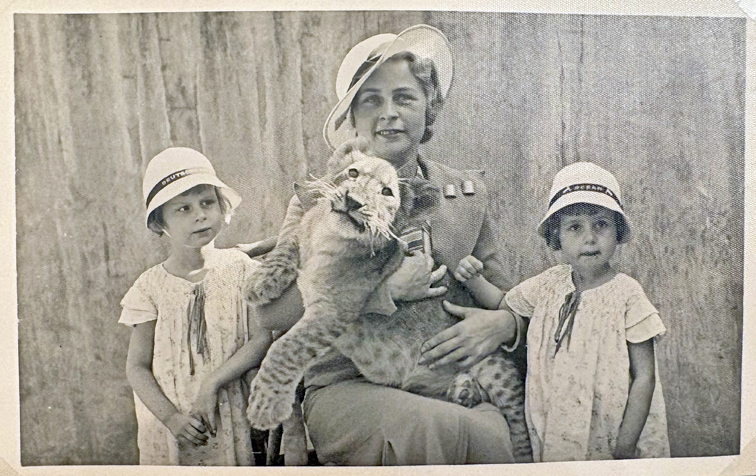
(Photo courtesy of Eva Guse)
In this 1934 photo from the Berlin Zoo are Else Fricke along with her two daughters, Hannelore, 4, left, and Eva, 3.
(The Hamilton Spectator – Saturday, February 14, 2026)
The soul is healed by being with children. – Fyodor Dostoevsky
BERLIN – The German capital knows winter these days. An ice storm recently canceled hundreds of flights including yours. But Tante Eva, your mother’s sister, has her warmth.
You’re visiting while returning to Canada from work in East Africa. It’s good. In any season, Berlin, your birth city, still makes your blood jump.
Eva, 94, lives on her own in the same Friedrichsruher flat she’s called home for more than 60 years. Defying age – five flights of stairs help – she hosts you with cakes and coffee and her gentle, thoughtful spirit.
Old photos, meticulously preserved, are brought out. Especially interesting is one from 1934, the three ladies wearing hats. Standing with their mother, Else, is little 3-year-old Eva and sister, Hannelore, 4, who would later become your mother. They’re at the Berlin Zoo.
Also posing, if that’s the right word, on Else’s lap is a young wildcat that’s not entirely small. Gosh. Such keepsakes could apparently be had from the zoo in 1930s Berlin. It was, maybe, like the Marineland you knew in the 1970s, a place not of thrill rides, but where people could somehow connect with the animals.
Hardships would come. First, another world war, the second one in 20 years. By the time Hannelore and Eva were teenagers – it was always the two girls – Berlin was marred and divided beyond recognition. The war-ending Battle of Berlin killed hundreds of thousands, including tens of thousands of civilians.
Later, Hannelore left for Canada, married your German-Canadian father and started a family, only to return to Berlin pregnant with you. After losing her marriage, then her two children in a bitter international custody fight, and then losing hope in a larger sense, she died in Berlin by suicide.
But this isn’t the end of this story, like it’s not the end of any story of any family anywhere that knows deep loss or hard times. After all, you’re in Berlin in 2026 on good terms. It’s a place of peace and easy reflection, even with the city’s painful history. Most museums and memorials are free for this reason.
Not so long after your mother’s death, your Oma and Tante Eva boarded a plane, Berlin to Toronto. To see you two kids. Imagine. You’re just a boy in the 1970s. Years later you’d realize, my God, the grace those adults had to muster to pull off that visit, swimming in that great sadness, that grown-up grief of losing a wife and daughter and sister.
You remember it like a home movie, you the 8-year-old with a mop of boyhood hair. You’re at home in Niagara with your sister and father and his big sideburns and purple Pontiac Parisienne. Now Tante Eva, who never had children, and Oma, visiting all the way from Berlin. They just had to see you. So they crossed the ocean. It’s really something.
You’re each there, full of nothing but the moment and, somehow, your broken togetherness. Then one day where do you all go? To the animals at Marineland.
Later, during your first solo visit to Berlin as a young man, Eva gifted you family valuables including the 8mm film that she’d shot during that 1970s Niagara visit. And for more than 50 years she’s sent packages and gifts to Canada, now to your own children.
She’s but one example of a storied thread connecting generations with honour. And isn’t this why we love old family photos? They tell so much, including how children can heal the soul. And in this there’s something about the resilience of the larger human family.
Thanks, then, for Family Day, for a break, for something different in places like much of Canada.
With any luck the holiday, not widely known globally, will grow. Because everyone has a family story. Then it gets stitched into the fabric of any given community. If it weren’t so, nobody would know where they come from, never mind where they’re going.
It’s been a while since I read a story told from this point of view! Something felt cognitively titled. That aside, I have enjoyed reading a bit of your heritage. Interesting discovery. The story has a vintage scent and reminds me just how resilient the human spirit can be.
A “vintage scent.” Love that.