
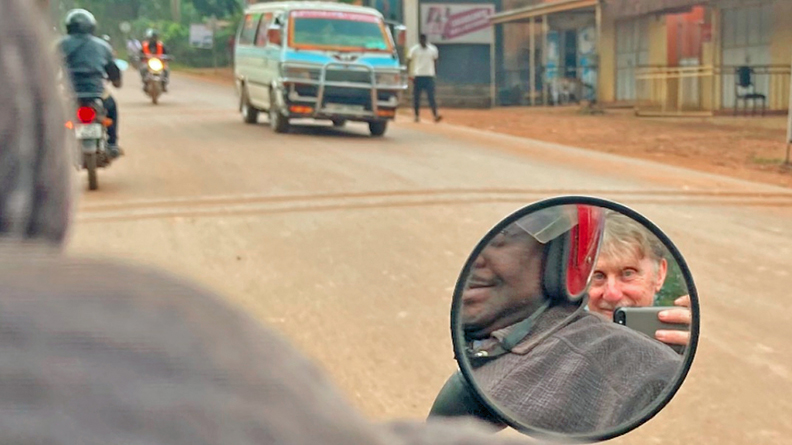
(Thomas Froese Photo)
The writer’s view from the back of a boda-boda driven by a Ugandan named Godfrey.
(The Hamilton Spectator – Saturday, January 24, 2026)
MUKONO, UGANDA — Before I tell you about the boda-boda driver Godfrey, let me thank the government of Uganda for helping with my recent internet cleanse.
Authorities turned the internet off during Uganda’s mid-January election to apparently give opportunity to reflect, to look in the mirror. I mean, really, how did the world manage before the internet?
Not that Uganda’s government is the only one to make such a fantastic maneuver. Even so.
Two days before the vote, from my annual university perch near Kampala, I talked with a Canadian friend in Germany on WhatsApp, the free platform that millions of Ugandans use. Hours later the internet went off. Like during the election five years ago. And, surprise, five years before that.
Millions of Ugandans were muted. (It’s election time. What’s there to talk about?) Same with the flow of mobile money going through millions of phones. It stopped. (What. Does business and trade need money every day?)
“Aren’t you disturbed without internet?” A Ugandan engineering student asked me on Day 2. “I’m working around it,” I said. No Netflix.
Ugandans were in internet darkness for five days but social media brownouts continued.
Nationwide, security forces killed at least 12, although the unofficial death toll is higher from unrest following President Yoweri Museveni’s return to office for five more years. Thirty minutes from where I stay at least one person was shot dead in an opposition MP’s home.
The 81-year-old Museveni has ruled Uganda for 40 years. Some voters, especially young, unemployed urbanites in Uganda’s central region, say his eventual passing is their only hope for a more democratic future. As one told me, “Nothing lasts forever.”
They support opposition leader Robert Kyagulanyi, the former musician known as Bobi Wine. After the vote – he campaigned in a flak jacket – he and his family were put under house arrest before he escaped to a location unknown. Previous opposition leader Kizza Besigye has been in jail for 14 months on treason charges.
Rural voters, significant in this nation of 46 million, often support Museveni. As do older voters remembering the pre-Museveni era when hundreds of thousands died during bloody reigns of Milton Obote and Idi Amin.
It’s context, because beneath the thin veneer of civility, any nation can have lurking beasts. Museveni represents relative peace. Thankful for it, one older woman told me, “We don’t have a democracy. We have a kingdom something.”
But about my friend Godfrey, a burly Ugandan with a large, easy laugh. He drives boda-boda, the East African motorcycle taxi that, somehow, gets you around. While aboard it’s my habit to talk to drivers while taking photos. It’s not an entirely safe routine, I realize, but it works well while I’m with Godfrey on election day.
And what do I see? Order and calm, mostly. I see people, warm and beautiful people, really, like any of us, muddling through this life, but with uncommon grace and resilience amidst challenges for food, shelter and education beyond what most Canadians can imagine.
“How are the children?” Godfrey asks. As always I show a fresh family photo, and as always he laughs joyfully. He names all three, remembering each well from when they grew up here. He congratulates me and my entire family.
Then he tells of the great sadness in his own fathering life. He had three young adult children similar age to mine, but his eldest daughter, for work, went to the UAE and died there recently of an unforeseen illness. Silence. Then a few words and hug before we part.
So life goes. It’s just one story, one example of how we live and move in a noisy, even dangerous world of politics and technology and shaky culture and more. But it’s other things, more human commonalities, even personal suffering, that can quiet the spirit and bring us closer together with perspective.
No, nothing in this world lasts forever. Somehow in this truth there’s a larger hope.
Quite sentimental! Thank you, Thom. And where did you get the courage to be in Uganda during election time with the internet off?
The courage belongs to the Ugandan people.