

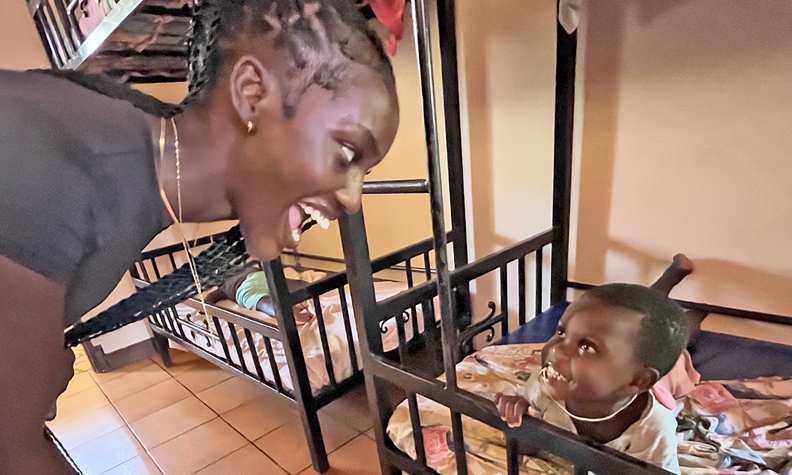
(Jean Chamberlain Froese Photo)
Hannah Froese has a moment with five-year-old Bayat from the Amani Baby Cottage in Jinja, Uganda.
(The Hamilton Spectator – Saturday, May 9, 2026)
We can’t talk about rescuing mothers without talking about rescuing children, never mind rescuing starfish.
But first, Hannah, my daughter. Not that she’s the only person in the world who’s ever been rescued. She’s not. But on a weekend to celebrate mothers, here’s her story.
It’s believed that Hannah’s birth mom was a university student on the move, on a bus possibly to neighbouring Rwanda. When she couldn’t go another inch she stopped in the western Ugandan city of Mbarara and delivered a child. That was 20 years ago.
Hospitals in Uganda aren’t the Ritz so mothers bring their own bedsheets, then often tie a piece to their newborn to tell everyone, “This one’s mine.” And in this case, “Please care for her. I can’t.” Then the young woman was gone.
Nurses in Mbarara’s hospital did care and named the little loaf Hannah. Eventually the infant went on a six-hour trip up the Masaka Road to Jinja, a charming fishing town on Lake Victoria with an upbeat orphanage named Amani Baby Cottage.
Three years on, Dr. Jean and Mister Thom and their own bambinos, Lizzy and Jonathan, took Hannah’s little hand and explained her new home. Here in Uganda? Yes. And in Canada? Yes. Wherever we are, you are. That’s home. Mum. Dad. Sister. Brother. The Froese 5. Let’s go.
We fostered Hannah in our care for five years before the Ugandan court got around to sealing the adoption deal on, fittingly-enough, her 8th birthday. Shortly later, Canadian citizenship. Now she studies at McMaster University.
But today’s fun fact – yes, your kids will grow up – is that Hannah, or Spicy Girl as I call her, recently flew Canada to Uganda, solo for the first time, for a teaching assistant gig at the Kampala international school that she and her siblings knew so well.
Shortly after landing she found herself, naturally, at Jinja’s Amani orphanage where Mum, that’s Dr. Jean who’d arranged the visit, shot a photo of Spicy with a little Ugandan named Bayat. There’s Hannah’s inner child loving it also, this returning home full circle.
There’s more to the story, even as there’s much to tell about the world’s estimated 146 million orphans, and more to share about Bayat, the five-year-old with the darling smile and light-filled face. Three years ago Bayat’s mother abandoned the girl to her father. Then he abandoned her too. A girl who’s not an orphan but is.
“Wow, that’s truly sad,” is all Hannah could say. This is how shadows fall in our world, when children are sacrificed on the altar of whatever in Africa or here or anywhere, really.
Locally, Save the Mothers – Jean is the founding director of the charity – held its annual Mother’s Day walk this morning at the Dundas Driving Park to raise awareness of these issues, especially kids left behind by moms who don’t survive childbirth. This remains common especially in sub-Saharan Africa and south Asia.
Between 2000 and 2015, after world health bodies focused especially on this old scourge, the global death rate plummeted about 40 per cent. Progress has since stalled. Imagine a couple of passenger jets full of mothers crashing. Today. Tomorrow. The next day. More than 200,000 moms still die in childbirth every year. Then the children left behind.
In a way we all need a new home and rescuing, if nothing else from our broken selves in a broken world. Even so, the mothers. The seashore is so large and the starfish so many. I, for one, will never tire of the story.
Multitudes of starfish have washed ashore, each one left to die. But a boy picks them up, one-by-one, throwing each back into the water. A cantankerous passerby sees the starfish-littered beach. “You don’t think you’re actually making a difference, do you?” he says.
The boy picks up a starfish, looks at it and throws it into the ocean. “Well, Mister, I did for that one.”
Another thought-provoking reflection. Thanks Thomas for always challenging us to slow down and reflect on what really counts in this broken world. Kind regards to Hannah and her mom Jean, and sister Liz on this Mother’s Day.
Beautiful Thomas! – thank you for sharing the story of your family.
It’s my pleasure.