

(Thomas Froese Photo)
(The Hamilton Spectator – Saturday, April 25, 2026)
So I was walking the dog with another dog walker and he told me how his daughter puts her boyfriend to sleep by reading to him.
Go on, I said, so he did. This father, Tim, told me about his daughter’s bedtime reading habits. And his. When Tim goes down, he reads, falls asleep, wakes hours later, like clockwork, then reads again, always a different book of a different genre, which gets him sleeping the rest of the night.
This is the relationship between reading and sleep, an interesting one considering we just passed World Book Day on April 23, and considering how students can doze off in high school English pretty well any day.
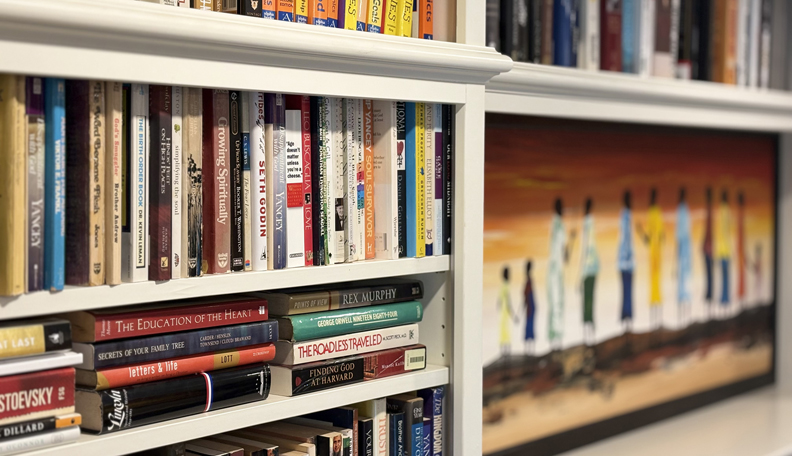
I read at night like I sip a glass of merlot. Or hot milk. Slowly. Then I’m easily out. My current night companion – moved to my bedside table from the downstairs bookshelves with the African painting – is “Fifth Business,” by Robertson Davies.
It was Marshall McLuhan, the Canadian prophet of media, who said the medium is the message. He’s right. So I don’t sleep with my phone. My wife would have thoughts on this. Besides, the ongoing message from my phone is that all hope is lost, so why bother waking in the morning?
Years ago, let’s say before the plough was invented, reading could go a mile deep in meaning, but just an inch wide in reach. After Gutenberg’s printing press, that became an inch deep of meaning and a mile wide of reach. Digitization now offers us a hairbreadth of meaning and ten thousand miles of reach. I told Tim. He agreed.
Which is to say that two aging guys walking their dogs can still offer the world a thing or two. I then talked about my son, the bright aerospace engineering student who was never really a reader. He recently told me, “Dad, you were right.”
I thought I’d misheard my dear boy. Then he shared he’s now enjoying books. I’d apparently once told him this would eventually happen, that he shouldn’t worry. At Christmas he even asked for Dostoevsky’s “The Brothers Karamazov.”
This leads to Karen Rodriguez, of the helpful platform Literary Fancy, and her recent thoughts on Russian literature being tremendous therapy. Your therapist, for $150 or so, might get you talking about your childhood or your self-destructive patterns. But for $22.99 Tolstoy’s “Anna Karenina” will tell you that so-called happiness isn’t really the point anyway. Meaning is. And you can learn this in your pyjamas.
So Jonathan, my son, you now know the truth of a good book. Karen (thanks again) says that the family systems theory in “The Brothers Karamazov” is, in fact, the best of Russian literary therapy. (Not that a good traditional therapist can’t be of help when needed.)
I didn’t read much Russian literature to my kids. But when the boy and his sisters were young, at pyjama time, I did read aloud. One starting place is The Chronicles of Narnia series. Then find all the Newbery Medal winners. Lois Lowry’s “The Giver,” about a dystopian society that ends pain – along with joy and other rather essential human feelings – comes to mind.
During school runs in Africa we drove more than an hour to get the three bambinos to their international school by 8 a.m. So at sunrise we’d sometimes already be listening to audio books. Mum. Dad. Remember this. In the car you have a captive audience.
Last thought. Ask Harvard University’s Elizabeth Duursma about her research showing that reading fathers, or father figures, often impact children more than reading mothers. Mothers tend to emphasize a story’s facts and details. Fathers tend to enact and elaborate.
So both mum and dad are needed and complementary. But never underestimate the power of a dad in our global village of storytellers. It’s not a bad thought to go to sleep with. Here. In Africa. Or anywhere, really.