

Thomas Froese
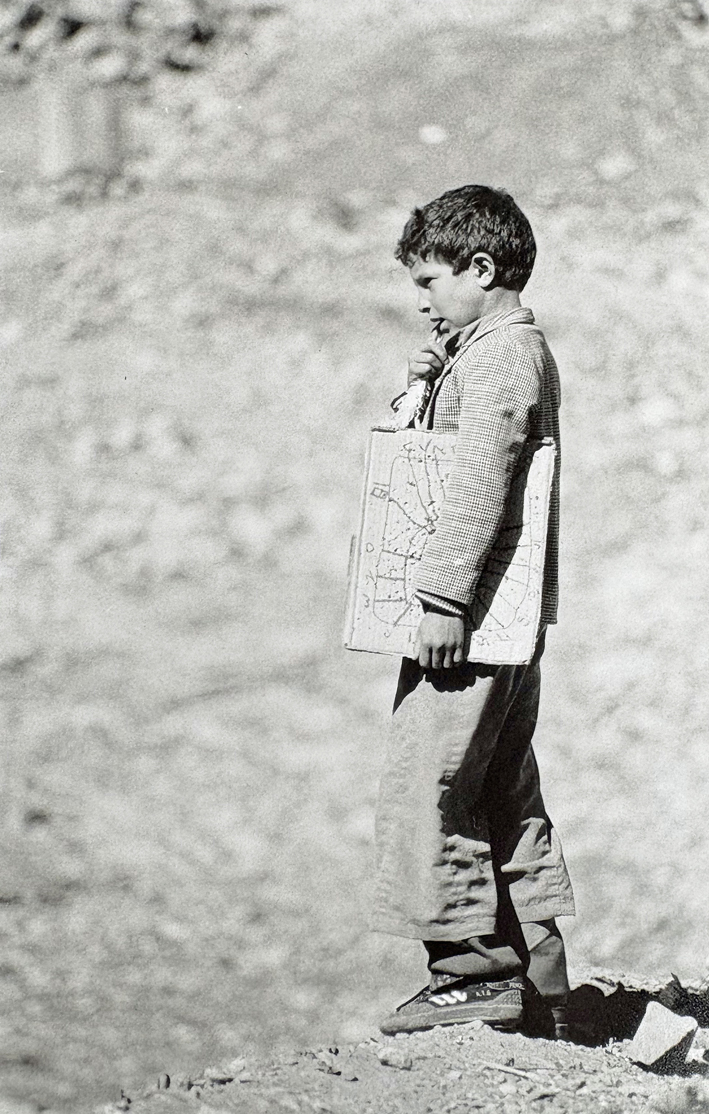
A boy in Yemen, one of the more difficult nations to be a child in 2026.
(The Hamilton Spectator – Saturday, November 21, 2026)
Talking about childhood, one day some years ago I saw a boy in Yemen, as plain as any Arab boy could be.
He wore a small, old man’s jacket and sucked a treat in one hand while holding a homemade boardgame in the other. He looked like he was thinking about things important to a boy of his nature.
Standing there in the middle of nowhere, he didn’t speak. But he seemed to say something anyway, namely that you can lose your childhood in two ways.
The first is from the misfortune of being born in the wrong place at the wrong time.
It’s something to consider because yesterday, Nov. 20, was World Children’s Day.
There wasn’t such awareness through most of history, no children’s day in, say, Edwardian England. That’s when “Peter Pan,” the story about the boy who wouldn’t grow up, was created.
James Barrie wrote it in response to his mother’s never-ending grief over James’ brother, David, who died at 13 in a skating accident. The Pan story somehow kept David, the boy who never grew up, alive.
In 1904, theatre goers in top hats and horse-drawn carriages first saw the show. Meanwhile, children across England and Europe laboured in domestic servitude or in factories or mines or shipping yards, this to keep their families from starving.
Remember, prior to vaccines – always a lively topic these days – children also routinely died of measles or scarlet fever or tuberculosis or you name it. Unlike in “Peter Pan,” the words ‘forever young’ meant simply that you died young.
The world, or at least enough of it, changed for the better. So did formal recognition of childhood. On Nov. 20, 1959, the UN adopted its Declaration of the Rights of the Child. Its cousin, the Convention of the Rights of the Child, adopted Nov. 20, 1989, became the fastest, most widely ratified human rights treaty ever.
The two-year-old who screams bloody murder when you’re getting them off to bed might make you think otherwise, but these global statements affirm what we’ve always known, that children are people, albeit little people, with rights as members of the human family.
Even so, in Yemen today, about 4.5 million kids aren’t even in school. More than 11,000 were killed or maimed in the worst of Yemen’s civil war from 2015-2022. In 2026, hundreds more have perished with renewed fighting between Iranian-backed Houthis and Yemen’s Saudi-backed government.
Civil war has displaced several million Sudanese children. Millions of Ukrainian kids don’t know when the next Russian attack might kill them, or their mom or dad. Millions more in the Democratic Republic of Congo, and Haiti, don’t have enough food. In Gaza, many thousands of war-traumatized children need clean water and sanitation.
Remember the American Tomahawk missile that killed at least 120 Iranian school children in February?
And according to the 2026 Kids Rights Index, it’s Afghanistan, where 11 million children need humanitarian aid, that ranks last of 194 nations for children’s rights.
It’s all childhood denied. Childhood robbed. Childhood stolen by time and place.
The second way to lose your childhood is by giving it away. This hits closer to home, especially for driven people and places.
You get so tied up in the exhausting work of proving yourself and fortifying your adult armour, that you lose any sense of the world’s wonder. You lose the fearless curiosity you once had. You trade in your imagination for squalid, grown-up conformity. You play for keeps now, not for fun.
In Peter Pan terms, you become Captain Hook. This is the other way to lose your childhood. You lose it carelessly, like you give away your birthright for a mess of pottage.
It’s hard to know which loss is worse.
Plenty of people might gladly lose the latter over the former. You needn’t know much about Maslow’s hierarchy of needs to know that it’s better to have a living body than a dead spirit.
Or is it?