

David Hou
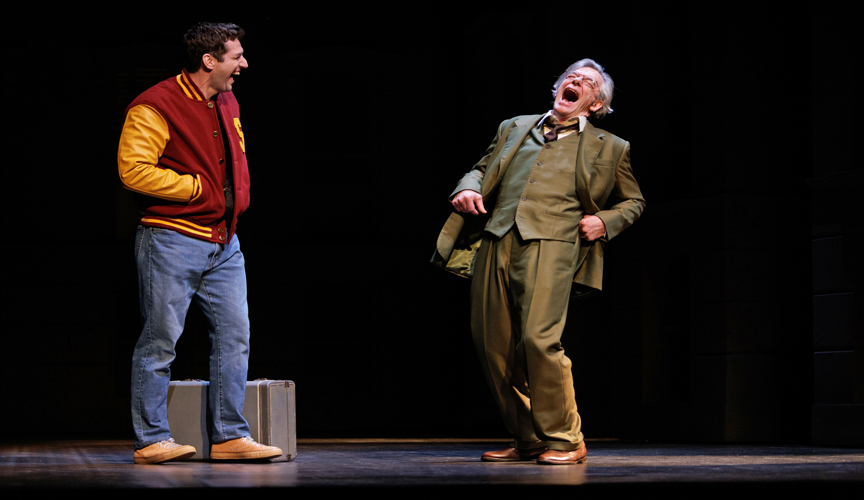
From the Stratford Festival performance of “Death of a Salesman” is, on left, Joe Perry as Biff Loman and Tom McCamus as Biff’s father, Willy Loman.
(The Hamilton Spectator – Saturday, October 17, 2026)
Before getting to Willy Loman and “Death of a Salesman,” here are salutations to anyone who personally knows the hard knocks of hard sales.
During an abundantly ridiculous time when I was learning to leave home, I got a sense of it, the performance and vulnerability involved, when I sold vacuum cleaners door-to-door.
It’s 1985, the year of “Back to the Future” with Michael J. Fox. There was this ad in the newspaper from some sales guy with his life. You know the life. The Ferrari. The opulent house. “Join my team.” Okay, let’s go, I thought.
So I left home, hopeful and desperate, and, on auction, bought what I could, a little red, Ford Pinto, the bloody lemon. Then, from my dumpy hotel room, off I went.
The gig went like this. You, the skinny kid, brought the gift, the silver tray, to the lucky winner. Previously, at a mall kiosk, they’ve given their home address and agreed to a product demonstration.
So you gift the tray, then, ta-da! You introduce the stunning vacuum and proceed to dazzle and clean every micro-particle for a city block. Then the deal, “Sir, ma’am, for you – I’ll phone my boss to confirm – I can come down to $699.”
One day you’re sent to a trailer park. People. Have you ever tried to sell a Filter Queen, not a small machine, to someone in a trailer?
Another day a woman receives her tray, then asks you to leave. You insist. “Ma’am. The demonstration.” She calls the police, so an officer visits the office boss – the guy with the car and mansion – who later winks and tells you, “Way to go.”
Gosh. Did I mention my desperation? Even so, in time, inside me, there was the death of a salesman.
Of course, today there are still desperate people selling things, not vacuums, mind you, from whatever porch or platform they may have. Consider all the illusions online.
More so, today, Oct 17, is Arthur Miller’s birthday. Miller wrote “Death of a Salesman.” If you’re of a certain vintage with half a memory of high school English, this play needs no introduction. At The Stratford Festival this season, it runs one more week.
True, for youth, live theatre isn’t always the first thing that comes to mind for a good time. A show from 1949? Even so, watching with me, my own son, 21, said, “That’s the best theatre I’ve seen.” Remember, through Stratford’s Play On program, students pay little for these world-class performances.
It’s Willy Loman’s oldest son, Biff, who, at his father’s gravesite, utters the play’s most telling line: “He had the wrong dreams. All, all wrong.”
This is what Miller, who wrote more than 30 plays, did best. He showed everyday people, not just the wealthy or famous, in high tragedy. People like you, or me, or the streetside addict, in noble struggles that somehow elevate us to more than we might imagine.
It’s easy to think otherwise in a society driven by economic interests. It’s easy to see our identity only in our work and the material goods that work provides. It’s an issue for vulnerable workers facing job loss, especially now in this community during the trade war.
Without work, then, what’s left? Just that illusion? This is Willy’s dilemma. It’s why “Death of a Salesman,” Miller’s best-known play, speaks across time and place.
It’s not just about some old white guy in New York trying to sell things to support his family and his shaky image. It’s about our inherent value coming from who we are, not what we do. That’s why we’re called human beings, not human doings.
And isn’t this the heart of it? Whatever we have or don’t have in this world, we’re made just a little lower than the angels, crowned with glory and honour.
Arthur Miller reminds us in this enduring story about, funny-enough, death. It’s a mystery how he pulls it off. Happy Birthday to him.