
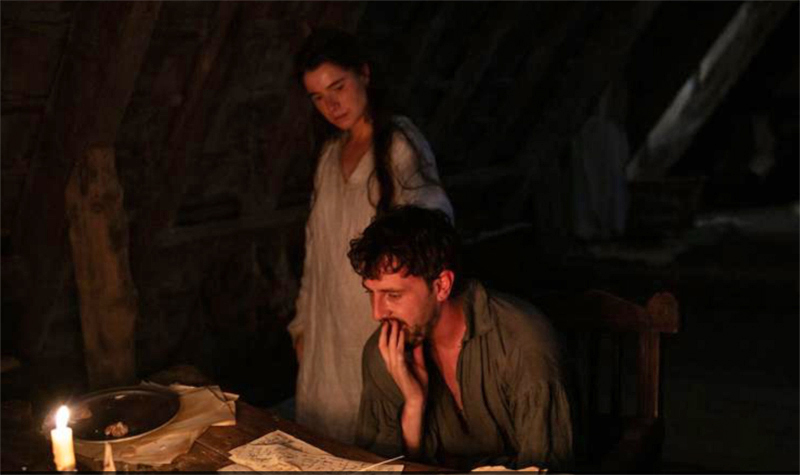
Agata Grybowska / Focus Features Photo
Jessie Buckley and Paul Mescal in a scene from “Hamnet.”
(The Hamilton Spectator – Saturday, March 14, 2026)
Before Sunday’s Academy Awards, here’s a family story.
He was 18 and she was 26 and pregnant, so they had a so-called shotgun wedding to save face, his and hers and the parents and the face of the family dog for all we know.
Despite the odds, the marriage of Bill and Anne then lasted until death parted them. April 23, strangely enough, was Bill’s birthday and death day, both. He died at 52, just one month after signing his will where he noted his “perfect health.”
Bill had wealth not from plying his trade as a playwright, but from real estate and ownership shares in theatres. For the family, he’d bought a Stratford mansion. Anne, according to the records, was left “his second-best bed with the furniture.”
It’s one reason why some believe their marriage was as cold as the ice in martinis that unhappy spouses can drink to get through another day. Even so, that bed, not for guests, was likely their marital bed. And Anne, under common law of the time, was entitled to one-third of Bill’s estate.
Besides money and sex, children are top of mind in marriage. Anne and Bill had three, including a boy who died around middle-school age. It wasn’t supposed to go this way. The boy had two sisters including a twin, Judith, who, almost dead at birth, was the vulnerable one. The plague may have killed the boy, but nobody’s sure.
We do know that despite the odds and popular misconceptions, most couples today – about four in five – who lose a child, stay together. Bill and Anne did, although, like men and women do, they grieved differently in their own time and deeply personal ways.
This brings us to the Academy Awards and “Hamnet,” a film to note tomorrow. It’s nominated for eight Oscars, including Best Picture, which says something about its depth and beauty.
Watching it, as a man, I’ve never thought more sincerely on matters of birthing or mothering a child. Or losing one. This is how good fiction works, leading us deeper into the mess of human experience. Good fiction is truth distilled.
Gaps are filled and liberties taken. This is certainly the case in historical fiction like “Hamnet,” the novel the film is based on. Author Maggie O’Farrell later worked with director Chloé Zhao to co-write the film’s screenplay.
Bill, that is William Shakespeare, and Anne, that is Anne Hathaway, were very real people. Historians have traditionally believed their marriage was frosty. They had two girls and Hamnet, the boy who died in 1596. With shrewd investing, Shakespeare did purchase a grand family home in Stratford-Upon-Avon.
The film adaptation has William and the pregnant Agnes (as O’Farrell calls Anne) marrying out of love, not social convention or fear of what the Joneses think. It focuses especially on Agnes, who early on sees the deep interior passages in her man. She saw Shakespeare before he became Shakespeare.
This, naturally, is the dream of every man, to have a partner who can look at what appears to be cavernous nothingness and see undiscovered treasure. And it’s from these mysterious places that Shakespeare, some years after Hamnet’s death, found a way to write the similarly-named “Hamlet,” among the world’s best-known plays.
This is often the case with wounded artists, and thank God it is. They seem to tell the rest of us that if God doesn’t seem to be giving you what you ask – never mind if you lose something dearly-held – then maybe he’s giving you something else. It’s a message for anyone, any time.
Even if you slept through high school English, somewhere along the way you likely picked up “To be or not to be?” That’s the existential and annoying question from “Hamlet” that lingers four centuries later. Do I exist and stick around to make something good out of the mess in this ridiculously-troubled world? Or do I simply exit life, literally or otherwise, stage left?
Shakespeare’s answer is clear.
So deep and carefully written. I have read it three times. And I dont mind a fourth time. Thank you, Thom.
Your best writing in many a post my friend: poignant without sentimentality; sensitively parsed, without being cloying. It is almost enough to drive me to see the film to discover if O’Farrell was able to overcome her femfiction fantasy rendered in that travesty of a novel she had the audacity to claim was an introspection on Shakespeare’s motivation in writing Hamlet. It was nothing of the kind. It was self-indulgent tripe better published by Hallmark, rather than the storied Alfred A. Knopf.
But films can overcome their written forebears, otherwise Philip K. Dick would has disappeared into obscurity long ago. So perhaps I will try to transcend the nausea induced by reading the novel and see the film. It certainly couldn’t be any worse than the book!
And just for historical record, while Hamnet’s tragic death may have been the seed for the play that bears his name, it was the death of William’s father John in 1601 that gave the play its final dramatic Incentive Moment, as well as providing the play’s Inciting Agent. You see? You crossed the line into my English teaching domain!
Yes, your domain, Steve. Thanks for sharing.
Emmanuel, that’s what good readers and writers both do — read, then reread. And again.