
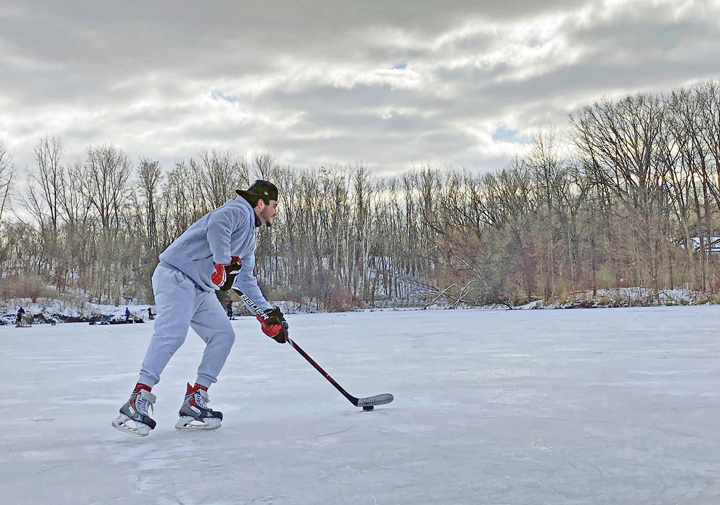
(Thomas Froese Photo)
A hockey player enjoys the open space of a frozen Lake Jojo, also known as the Dundas Marsh.
(The Hamilton Spectator – Saturday, February 28, 2026)
“Here we go again.”
That’s all it said. The note came from an American friend from over the border.
It was just before overtime last Sunday morning, before Team Canada and Team USA were to finish their Olympic gold hockey battle in Milano Cortina. My friend Brian knew Canada’s winning history in overtime, especially against the U.S. We knew how this would end.
But Jack Hughes didn’t get the memo and scored America’s golden goal. A week in, some of us are still processing the unfortunate truth that in 2026 Canada’s Olympic hockey teams, both men’s and women’s, fell to the U.S. in overtime gold medal games.
Have we somehow slipped into another universe?
Apparently, if life can be a game of inches and seconds, then all the more in sport, especially in this game that’s deeply etched into our nation’s psyche. As one sportswriter put it, in Canada you can walk into any Tim Hortons anywhere and say, “You, you, you, you, you and you,” and get a formidable team.
This understanding began in 1920 when the Winnipeg Falcons won gold for Canada in Antwerp, Belgium, in hockey’s Olympic debut. Most of those players were first or second generation Icelandic-Canadians who’d settled around Winnipeg.
So Canada’s game has always been shared, even in unexpected places. Dave Bidini’s book “Tropic of Hockey: My Search for the Game in Unlikely Places,” explores this nicely.
After last Sunday’s game, Brian, who’s a lawyer from Georgia, sent a second note. “Full circle from your house when Crosby had his golden goal.” That was 2010. With other Americans fittingly gathered in my family’s former Ugandan home, he’d watched, on a half-functioning internet feed, that Canadian overtime win over the U.S. in Vancouver.
Brian was also among expatriates playing ball hockey behind that house in Africa. It took time to move a significant wall of earth, then build an asphalt pad. But what’s a few years? From Yemen, I’d also brought heavy NHL-sized nets acquired from a Canadian there.
Locals and visitors alike then played. Hard. One day a Canadian flew back home with a cracked rib. The Ugandans especially fell in love with it all, amazed when later discovering videos of NHLers “running with skates on.”
And how Canada has run since 1920. Besides other world titles, Canadian men have won nine Olympic golds, five silver and three bronze, more golds and medals than any other nation. For our equilibrium it’s good to remember as we continue this amorous relationship with ice and stick and puck.
The contenders deserve credit. Players from Russia and the former Soviet Union have won plenty of international tournaments, including the Olympics. Since 1920, the Americans have three Olympic golds, Sweden two, Finland and Chechia one each.
The subplot in 1920 was that Canada’s gold honoured Frank “Buster” Thorsteinson and George Cumbers, who were killed in the First World War.
The subplot in Milano Cortina was that the U.S. win honoured the memory of “Johnny Hockey”, Johnny Gaudreau, killed in 2024 with brother Matthew by a suspected drunk driver. His boy, Johnny Jr., at the game with family, turned 2 years old on gold medal day.
Then, as Brian wrote me, “And for the winning goal to come from the guy who had [parts of] his teeth knocked out. Hockey players are different.”
America’s first Olympic hockey gold, by the way, came 66 years ago today, Feb. 28, 1960. Player Bill Christian’s son Dave Christian played on its next gold medal team in 1980. Bill’s grandson Brock Christian Nelson is on the 2026 winning team.
So if the universe insists on unfolding as it should, maybe it’s somehow bearable to share with opponents who can give you a good run and a good story, both.
Otherwise it’s just you with that stick and puck, by yourself, maybe in the soft light on some inviting lake. All things considered, that’s another golden place to be on some Sunday morning, or any time, really.
Thank you for the research you’ve dug up for your readers. I had no idea Canada has won nine gold medals in hockey since 1920.
I appreciate your column, Thomas.
Thank you.
Nine and counting, Cori. We’re going to keep that big picture in mind. Glad you enjoyed.