

(Thomas Froese)
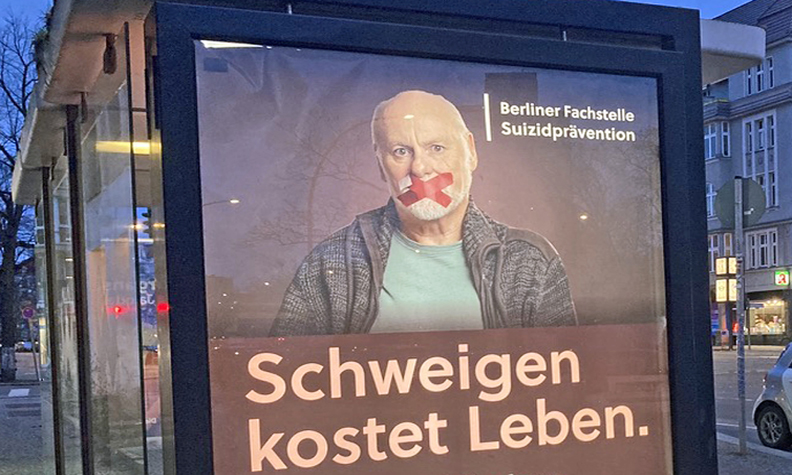
A suicide prevention message on a bus shelter in Berlin, Germany.
(The Hamilton Spectator – Saturday, May 23, 2026)
Wander just about anywhere in our time and find something about mental wellbeing.
In Berlin I once passed a bus shelter ad saying “Schweigen kostet Leben,” or “Silence costs lives.” An aging gentleman has his mouth taped shut. Someone’s father, likely? Grandfather? It’s an image to slow you down. Give words to your sorrow is its message in any language. Don’t bottle things up. And don’t be silenced. It might kill you. Or others.
“Give Sorrow Words” is also a worthwhile book by Lynn Keane, a mother who once shared at a Hamilton breakfast gathering – we were about 400 – about her son Daniel, just 23 when he died by suicide.
That St. Joe’s Healthcare Foundation event also gave microphones to others to share about their own loved ones lost to suicide. Broken hearts everywhere amidst the bacon and eggs and toast and clattering of dishes. I’ll never forget it, the sorrow expressed.
But the politics of suicide, the zeitgeist that sucks and blows at the same time, brings special grief. On one hand, let’s live well. Get help. Give help. Let’s especially support our youth. On the other hand, in Canada we’re exiting this world with increasing and frightening indifference. Forget about living well, my friend, in truth you don’t have to live at all. The voices are there.
The Suicide Prevention Community Council of Hamilton – it’s having a fundraising meal next week – is one local organization to thank for its ongoing work in this baffling space.
About 4,450 Canadians now die by suicide annually. Despite surging during COVID, this is its lowest level in 20 years. But suicide’s first cousin, MAID (Medical Assistance in Dying), has risen sharply since its 2016 start. About 16,000, or five per cent of all annual deaths in Canada, are now from MAID.
And Ottawa still has the nagging question of expanding this state-sanctioned death to people suffering solely with mental illness. Before summer break a joint parliamentary committee will recommend to government to keep the expansion on track for 2027, or not.
First scheduled for 2023, then 2024, now 2027, expansion has been delayed repeatedly because there’s no consensus on abandoning the most vulnerable people in our society. It’s simply impossible to separate someone’s treatable mental illness with their desire for death.
We’re not ready, nor should we be. This is the message from various communities, including concerned physicians and people with disabilities. As citizens and policy makers the need is to work together to improve the lives of the vulnerable, not end them.
One warning recently came from Dr. Jim van Os, a psychiatric expert from, interestingly, the Netherlands, hardly a bastion of conservativism. He told the committee’s MPs “Don’t do it.” Suicide contagion is one possible price of expanding MAID.
The overwhelming majority of the world has this understanding. Of 195 countries, only 11 have fully-regulated MAID. Three – the Benelux nations of Belgium, the Netherlands and Luxembourg – have it for solely mental illness. Three.
No wonder. Physicians have been guided for centuries by the essence of the Hippocratic Oath, to work for life, not death. Not that you need be a doctor to know in your bones how right it is to help the vulnerable. This shows the better angels of our nature. For this we can always be ready.
There is the dying with dignity argument, especially for exceptional suffering. But globally about 160,000 people die daily, most from natural aging, and all with the inherent human dignity we’re born with. MAID, as if some home service coming in to fluff your pillows before doing you in, is a global anomaly. There’s far more dignity in protecting the voiceless.
You or I can choose to believe otherwise, but we may later find that when we’re in need, nobody is left to speak for us.
If you or anyone you know is struggling with a mental health crisis, call Canada’s Suicide Helpline 988. Charitable donations to the Suicide Prevention Community Council of Hamilton can be made at www.spcch.org
Yes, the push for more MAID in Canada by the federal government (since 2016) is alarming, and in my opinion obscene. In a country that abolished the death penalty decades ago this amounts to a return of the death penalty, but for the “crime” of being elderly, or sick – mentally or physically. Soldiers injured in war have been told they should now die so that the government doesn’t have to support and help in their care. Also, in a country renowned for its “free health care for all,” this is an abrogation of that social contract which we all have paid for during our lives through high taxes. I won’t further touch on the recent decline in health care services with the ER’s closed for days in more and more communities and the difficulties faced by many in finding a family doctor.
You mention the situation of dying with dignity, and some people – or maybe many people – can sympathize with this, depending on one’s personal (often religious) beliefs. For those suffering from an incurable and rapidly deteriorating condition, one can certainly empathize. Only if one unfortunately finds themself in such a position can the full weight of such a decision be known and felt.
Those who have been around a while may recall the legal battle of the courageous Sue Rodriguez. I won’t review it here, you can Wikipedia or Google her story. Personally I felt that she showed a courage that I doubt I would have myself. But I really don’t know. I am not in her position. And hopefully never will be.
But I do personally know a handful of people who have chosen MAID due to a severe and rapidly progressing incurable illness, almost always cancer. I cannot imagine what it takes to schedule the time of your own death in such a way. I hope that I never have to make that choice, but did see the pain and physical deterioration they were experiencing prior to their decision, some moving up the date as they could no longer stand to live. I understand.
Therefore, as a decision made by an individual of sound mind whose quality of life will soon become unbearable, dying with dignity is an issue to be considered. I differentiate this from suicide, which thousands choose for other reasons, and I am greatly saddened that they felt that was their only option. More so, I think their families and loved ones suffer as well, in unimaginable ways to me as I have not endured that situation among my family or close friends. But I have known other families experiencing that loss, and would comment on their grief, but they seldom show it publicly.
These are just my own thoughts, my own opinions.
A critical topic, relevant and becoming more prevalent in Canada now. Thank You for writing about it.
Thank you, Thomas, for another insightful message, especially the line, “Not that you need be a doctor to know in your bones how right it is to help the vulnerable.”
Blessings
Peter D
Indeed.
Thank you Dan for taking the time to articulate your thoughts.
Thank you for this article, greatly appreciated, well addressed as always.
A family that works together and stays united is successful. Many have died for our country of Canada, for its freedom. The very least we could do is strive to help and be compassionate.
We should all be willing to help, volunteer, if we are in a position to do so. My dad is 95 and I feel it’s an honour to visit and help him. It’s more blessed to give than receive.
Let’s all help and encourage one another in this great country of Canada.
The real crime is what they need to focus on, ruining our country after many have died for our country. These precious folks would never hurt anyone.
Compassion. Encouragement. Thank you, Susan.