

Thomas Froese
(The Hamilton Spectator – Saturday, July 4, 2026)
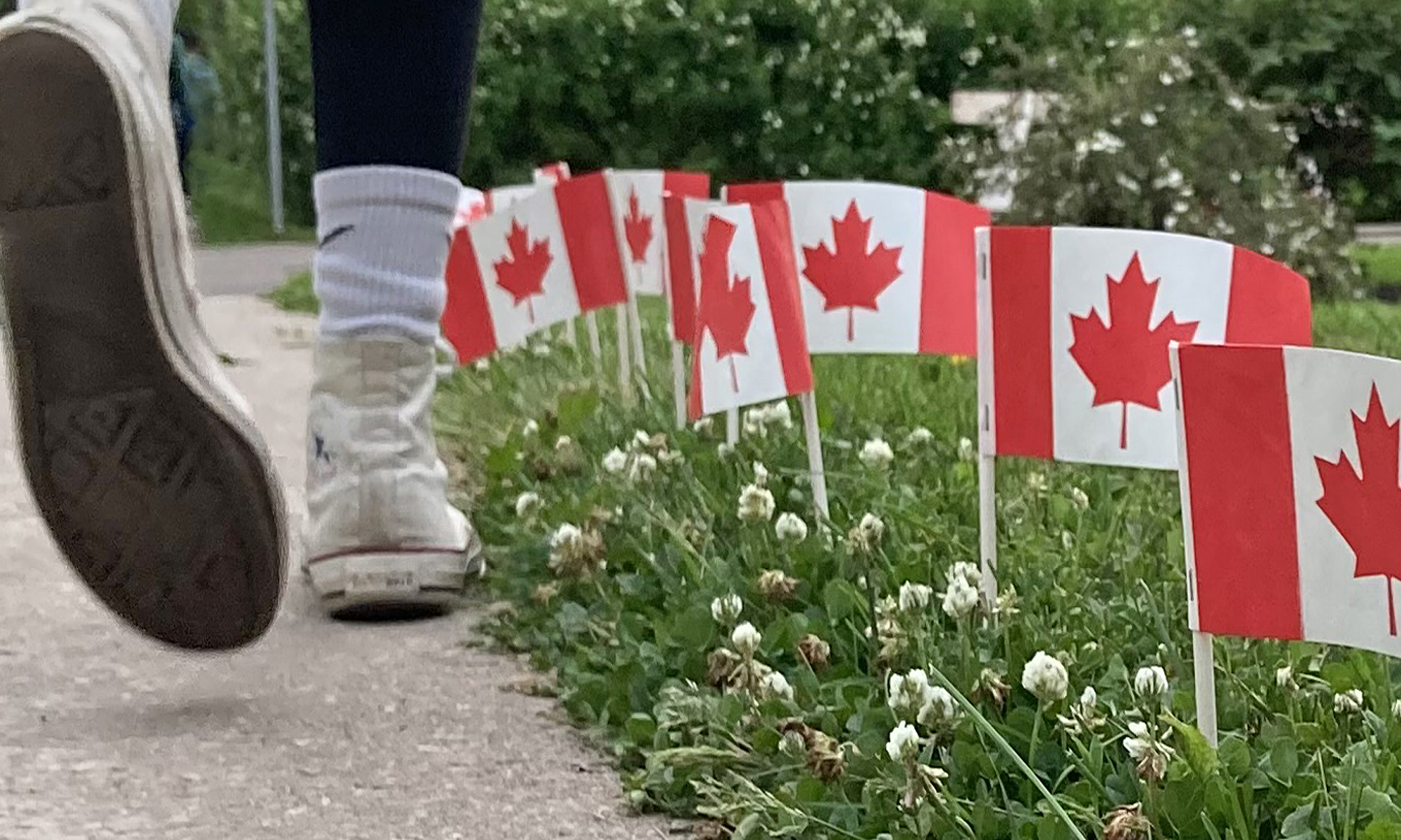
One day a few summers ago I saw a pair of feet in old sneakers pass a row of small Canada flags placed along a walkway. It was in Charlottetown, PEI, on Canada Day.
Fitting, considering Charlottetown is Canada’s birthplace. The feet, of course, could be from anywhere.
So I photographed the feet and the flags. They seemed to show that, like you or me, Canada is journeying through its days.
Nations can also plot and scheme and rage through their days. You need not look far to see this. You need not be a professor of history or geopolitics, or a high-rolling poker player.
“You have no cards. We have cards.” (No you don’t. We do.) “Have you lost your mind? Are you blind? Look at your hand. You have zero cards!” (Do you know the cards we have?)
Such are today’s world headlines, swagger from what’s become a kindergartener’s sandbox.
In either case, in July 1867 a northern nation of people, hewers of wood and drawers of water, was born. They were given cards, so to speak. Mountains of natural resources, for one. And a peaceful political evolution that left a gentler spirit flowing through its generations.
The young nation punched above its weight. From sea to shining sea it embodied a certain spirit of refuge. Abroad it fought sacrificially for friends and freedom. At home it was a balm of healing for the foreigner. Not that it’s a perfect place. But while journeying it eventually got its own flag, one with a bold leaf to reflect its calling, this restorative, healing spirit.
Speaking of feet and flags, its soccer team eventually developed and brought its people together, this in 2026, a summer surprise just when these people needed some bringing together.
It reminds me of children marching around a soccer pitch in East Africa during their Kampala school’s annual International Day, hundreds of kids, mine included, some sitting on parents’ shoulders, waving flags and placards, wearing national colours and costume.
They’re from Uganda and Pakistan and France and South Korea and dozens of places from the world’s family of nations, these children then running to the field’s many food tents. In Canada’s case this always involved getting Kraft Dinner in-hand.
Now, briefly, about the World Cup’s post-game “Handshake for Peace” protocol involving team captains. Can’t organizers learn from hockey – thanks Canada – and have all team players formally shake hands so the moment has some meaning? Just saying.
Of course, you can’t shake hands after a sporting match with your feet. A hand is not a foot. And a foot is not an eye. An eye is not an ear and so on. It’s good to remember how this relates to the world’s body of nations. Different countries have different roles.
This is why nationalism, at its best, is nothing to fear. We’re born where we are for a reason, planted or replanted in one place or another for a purpose. Nobody should feel doubt or shame about this even as nobody should have inflated hubris. We’re dependent on each other.
Canada Day this week was a time to think about it.
The other thing that the world’s nations can think about before going to bed at night is that even the best of them, the best empires, if you will, or the worst, won’t last forever. Not any more than you or I will.
The Assyrians fell to the Medes, who fell to the Babylonians, who fell to the Persians, who fell to the Greeks, who fell to the Romans. It would make for fine and entertaining football to see these old powerhouses of history running after a ball on some pitch in their robes and sandals.
But if we’re talking about journeying and finding a measure of joy on that journey, numbering your days is a good place to start. Because one more day that you’re here is one less day that you’re here.