

(Thomas Froese)
(The Hamilton Spectator – Saturday, September 5, 2026)
In the category of “Why is life so interesting?” let’s start outside a café in Port Stanley where I recently sat in the morning sunshine with my coffee. There I spoke to a stranger.
She was from Chatham, she said, about an hour away, but meets her children and grandchildren in a rented cottage during summer. I told her I’d been a reporter in nearby St. Thomas and it’s good for my soul to return for a day or two every year. She asked if I knew Lori Rieger.
“Very well,” I said. “In the 1990s we worked in the same newsroom.”
“I’m her mother,” she said.
Really? Come on. Let’s take a photo to show Lori.
Not long before, in Grey County, I’d stopped in the charming village of Neustadt, birthplace of former Prime Minister John Diefenbaker and home of a few hundred people.
A senior couple sat on a bench outside Granny’s General Store with its Canadian flags and quaint heritage. It was an interesting scene, so I took a photo before we talked.
Doug and Penny were from Belmont, south by two hours if you take the back roads, which I often do for the sheer pleasure, wherever I may be going. I eventually said I was from Hamilton, but I know Belmont from that previous reporting life in Elgin County. Then I took off my sunglasses.
“Wait, are you Thomas Froese?” This is what they asked. Then they said they remembered when I got married. It was something.
“That was 25 years ago,” I said. So I showed some family photos. Why not?
This is the best part about growing up. Mum and Dad are no longer telling you about stranger danger. I mean, if you never talk to anyone, how are you ever reminded that we’re all hopelessly closer than we realize on this spinning ball in space?
You’ve heard of six degrees of separation, the theory that two people anywhere can be linked through no more than six social connections or acquaintances? Social media is making this distance even less.
You need not be a saint like, say, Mother Teresa, who died 29 years ago today, Sept. 5, to appreciate this. “Not all of us can do great things,” she said. “But we can do small things with great love.” Maybe you or me talking to some stranger is one such small act.
These small acts are not to be confused with “Small Axe,” an old Bob Marley song about the proverb, “If you’re a big tree, we’re the small axe.” It’s about people abusing power.
Take the comical manoeuvre to rename Lake Ontario. The better option to Lake America is clearly Lake Small Axe, a good reminder that enough small axes swinging together can take down any old, hollow tree.
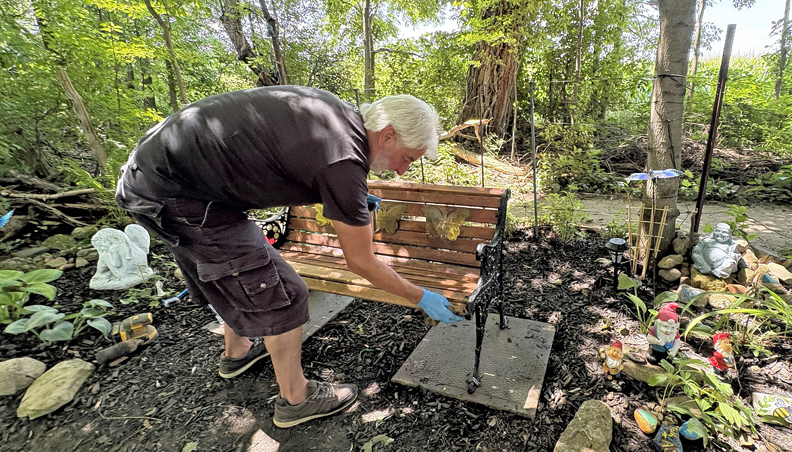
In either case, in Neustadt, along a walk called the “Trail of Dreams,” I spoke to another stranger, a gentleman with hair thoroughly white. Working on a memorial bench, he told me his name was Tom.
The bench had three commemorative butterflies. One was for Tom’s wife, who died from cancer. One was for a stepson, found in a ravine after either slipping down or being murdered. One was for another stepson who died by suicide.
Then Tom told me that a certain flower, the Star of Bethlehem, had recently shown up, growing unexpectedly in that space he’d created for strangers to stop and sit and think about things. So I took a photo of Tom and his bench, too.
And isn’t this the truth of it? People are easily divided by class and politics and race and gender and a million things. But at a deeper level it’s suffering that binds us together.
The other significant bond that humans share is love.
Some days you’ll come across suffering and love in the same place. When this happens it’s a good idea to pay attention. Life itself seems to hang in the balance.
Yes, yes, yes! Thank you!
Thanks for this, Thomas. “Some day you’ll come across suffering and love in the same place. When this happens it’s a good idea to pay attention.” That one may go on the wall of my studio :).
Steve
We were strangers when we met waiting for a plane to Uganda in the Amsterdam airport a few years ago and discovered we had mutual friends!
Love this post. The simplicity, and the opportunity to uplift one another, on a beautiful summer day. Thank you, Susan
Of course.
On your studio wall? Why not?